Getting Dirty With It
In March I gave a talk on bonsai soil at the Bonsai Society of Victoria club meeting. Dean Shaw, who supplies nearly all of my raw mix materials, joined me and chipped in along the way. This is the written version of that talk.
A big grain of Pumice
Whenever it comes to mixes, take everything with a grain of salt. Everyone has their own opinion, their own magic mix and what you read one week changes to the next. The aim here is not to hand you a recipe, it is to give you the tools so you can work out your own.
And if your bonsai are already healthy, strong and growing, you are probably already doing something right. You do not need to change everything on account of what you read here.
How I got here
I started the way a lot of people do, with potting mix straight from the bag, growing out seedlings and whips. Then I picked up a bag of "bonsai soil", I opened the bag and it stank. Assuming it was just fertiliser or just its smell I planted a heap of trees into it. A little while later they were all wilting and going black. I removed them from the mix and transplanted into a club provided free draining mix, luckily most bounced back. Lesson learned, not every mix is reliable and you should always trust your nose.
From there I continued using the free draining club mix, then started adding scoria and eventually landed on a custom mix heavily influenced from Scott Martin at Bonsai Matsu.
I knew from results the mix was working well but I wanted to know why, why did a free draining mix work well for bonsai, why is it so much better than potting soil? That question is what this talk is really about.
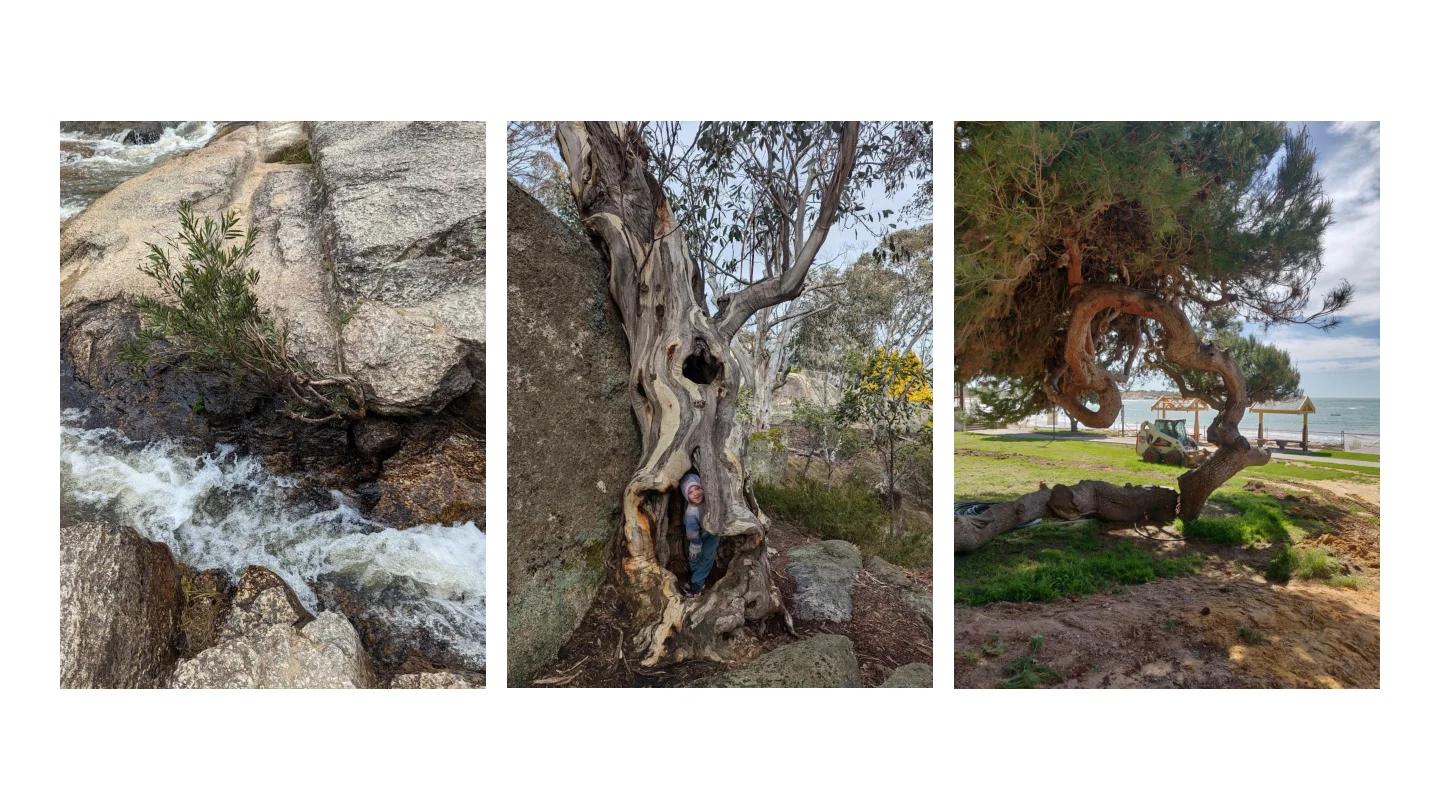
Since becoming obsessed with bonsai, I keep spotting trees in nature that are growing out of cracks, hanging off cliffs and others clinging for dear life to river rocks. This is survivor bias because we only see the ones that made it. But it still tells you something, trees find a way and whatever you put them in they will probably grow. The question is how to get the most out of them so they stay healthy enough for all the styling we want to do.
What do trees actually need from soil?
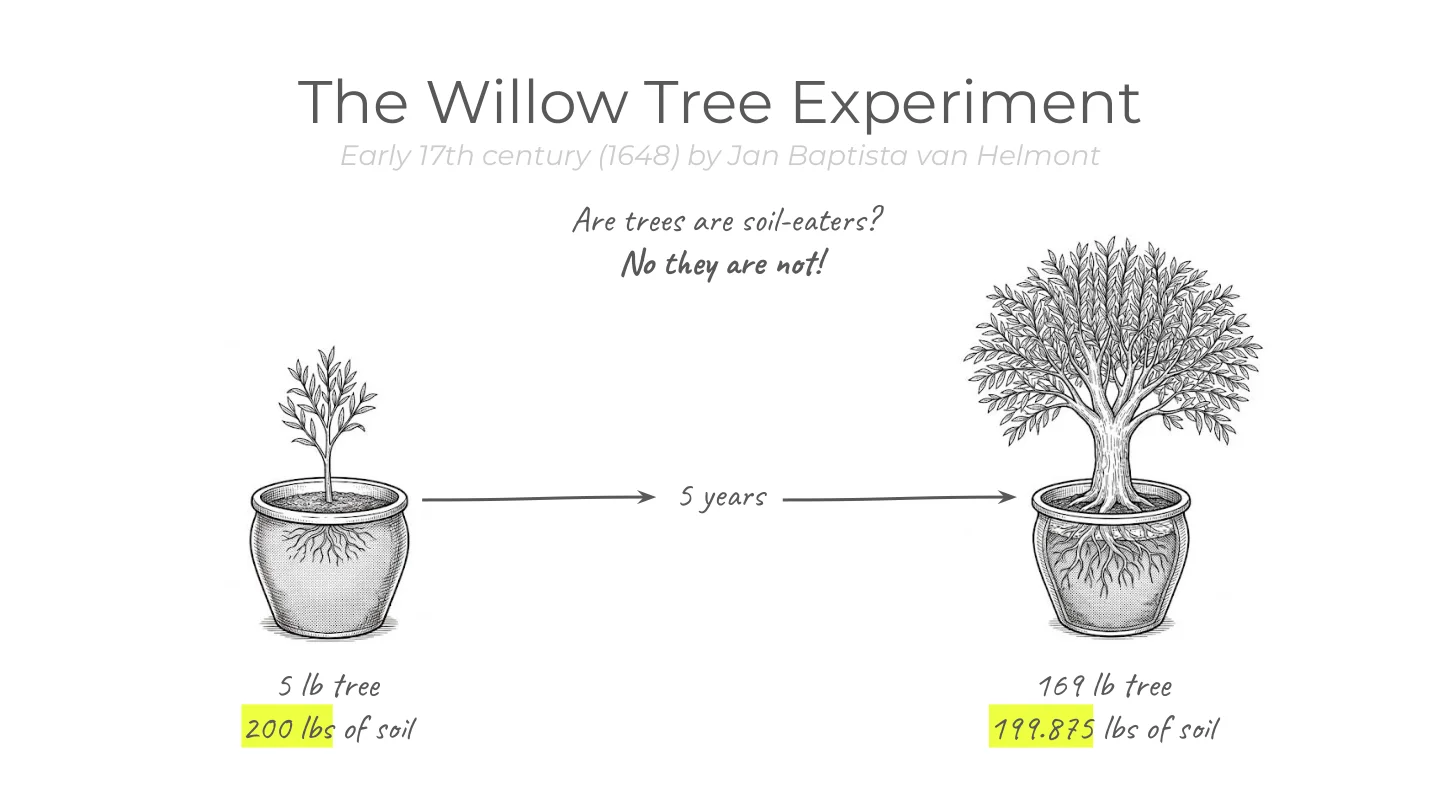
In the 1600s Jan Baptista van Helmont wanted to test the idea that trees grew by absorbing soil. He planted a 5 pound willow in 200 pounds of soil and let it grow for five years. The tree weighed 169 pounds at the end, and the soil only had lost about two ounces. The tree was not eating the soil.
His best guess at the time was that it must be the water in which a tree gains mass. We now know most of a tree is built from carbon pulled out of the air by photosynthesis.
So if the tree does not grow from the soil, what does it need from it? It needs: Oxygen, moisture, insulation, nutrition and support.
Why roots need oxygen
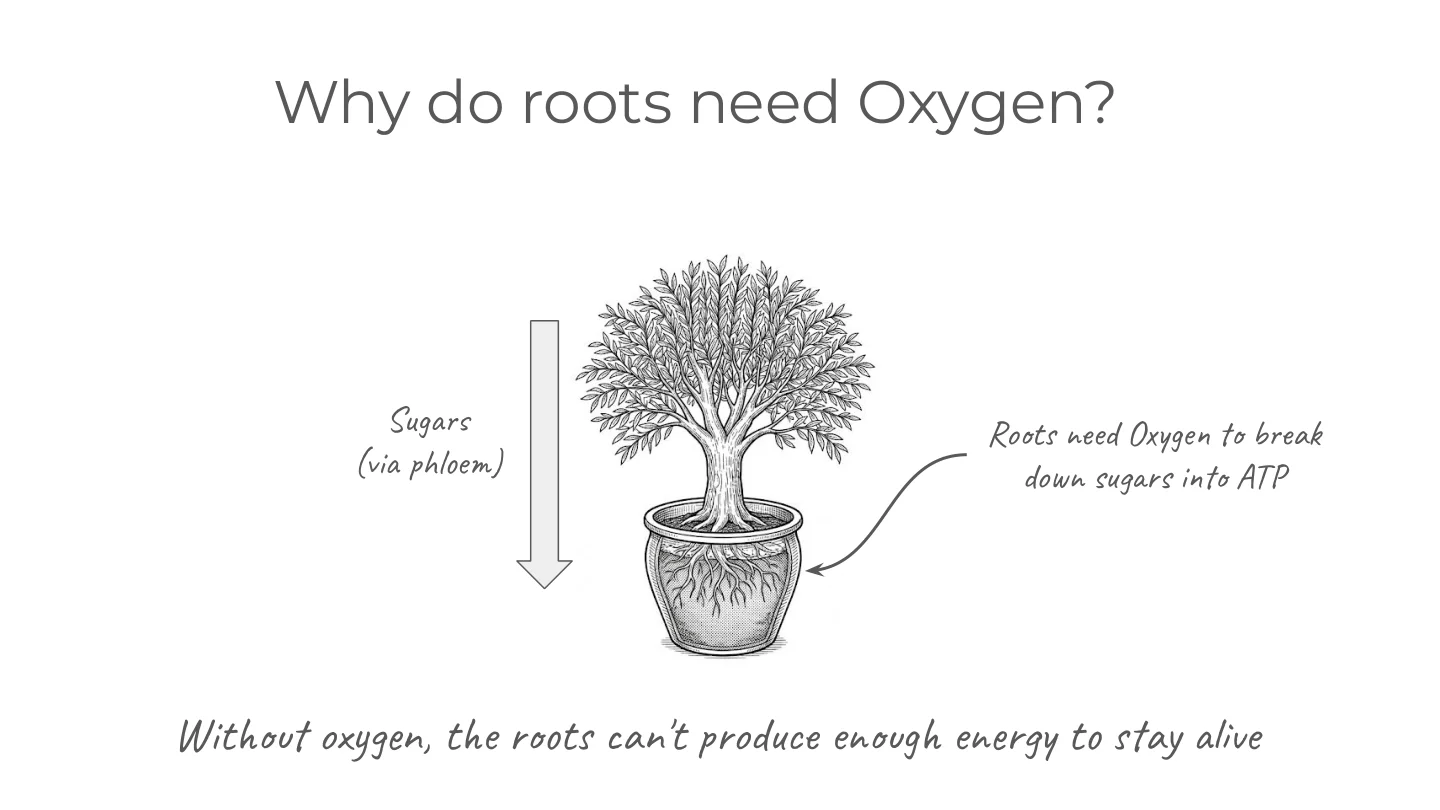
Roots cannot use the sugars sent down from the leaves without oxygen. It is a chemical reaction in the roots that turns sugar into ATP, the energy the root cells run on. Without it the roots cannot produce enough energy to stay alive.
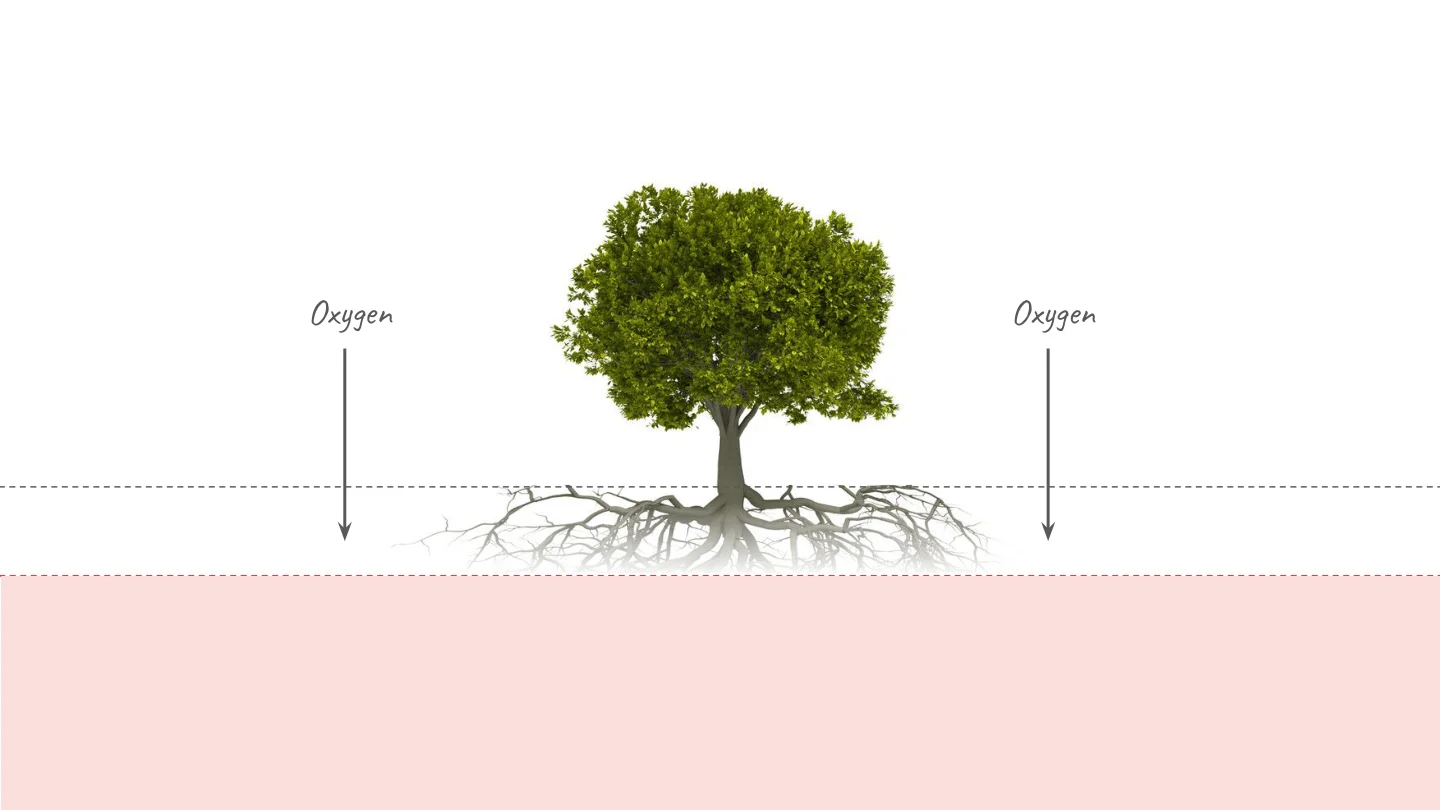
But hold up don’t trees already produce oxygen? They do, but a tree has no heart or blood to carry it. Its vascular system moves water and sugars, not oxygen, so the oxygen made in the leaves never travels down to the roots. The roots have to get their oxygen from the air in the soil, and that air has to get into the soil somehow.
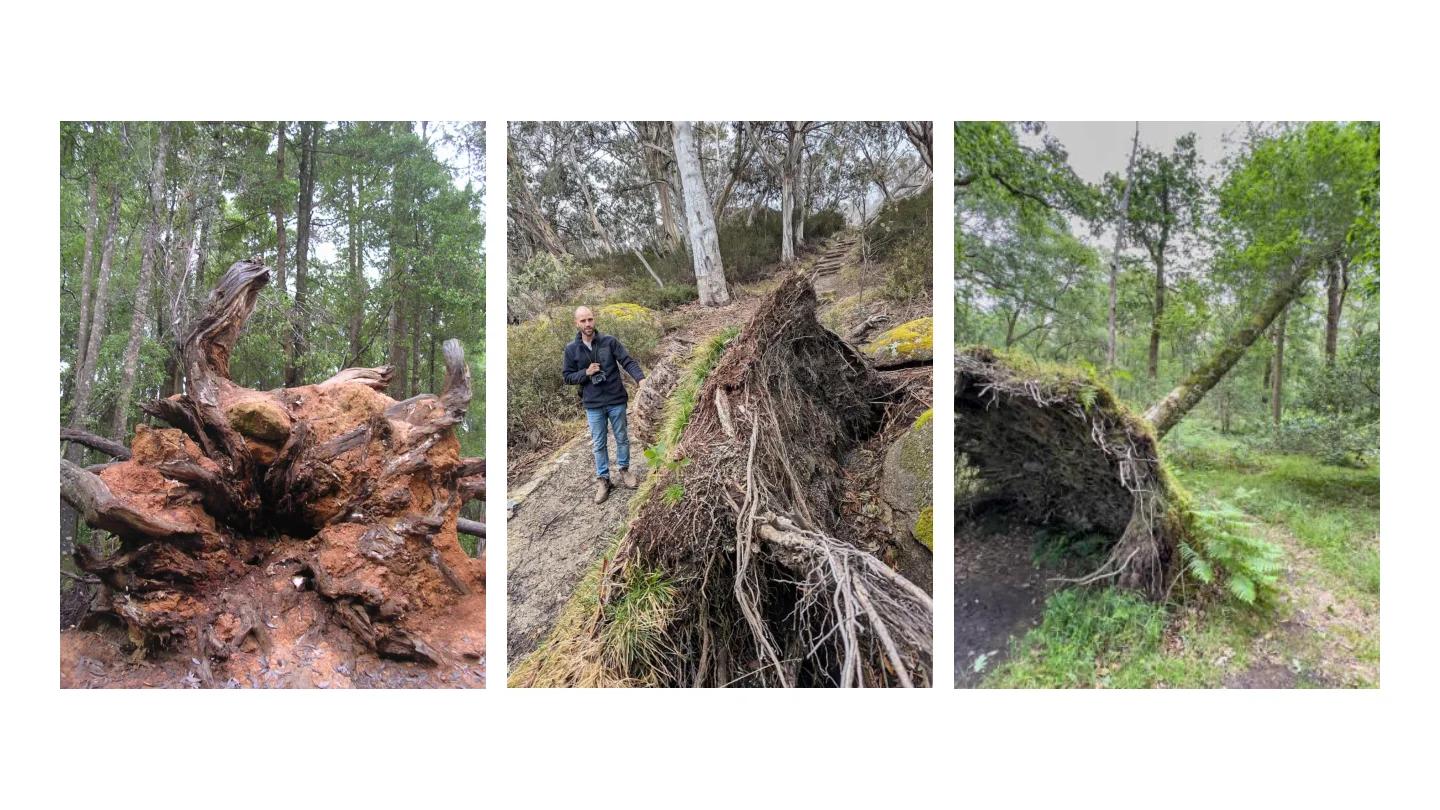
This is why roots in nature are much shallower than the classic diagram where the root system mirrors the canopy. Oxygen only penetrates so deep, and roots grow where the oxygen is. Next time you walk through a forest and see a tree that has come down in the wind, look at the root plate. It is shallow and spread out. Trees do put some roots deeper for stability, but most of the root mass runs horizontally looking for water, nutrients and air.
That is great news for us. A shallow bonsai pot is pretty much what trees want to do anyway.
What about plants grown in trays of water?
Water is not the problem, a lack of oxygen in the water is. Moving, well oxygenated water is fine, and plenty of species handle it well. Stagnant water full of decomposing organic matter loses its oxygen, turns rancid, and the roots effectively stop breathing. How much a tree tolerates also depends on the species.
Why roots need moisture
Roots pull up water and minerals, which travel up the xylem as a kind of mineral water. The fine root hairs do most of the absorbing, and if they dry out for even a short time they shrivel and die. Until they regrow, the tree cannot absorb water or minerals. That is why a tree can still look/stay wilted after you water it and not improve. The damage was done while it was dry.
The leaves are connected to all of this. Tiny pores called stomata open to let carbon dioxide in, and every time they open, moisture escapes. That loss is what pulls water up the tree from the roots. When there is no water to draw up, the stomata stay shut, no carbon dioxide gets in, no sugars are produced and growth stalls.
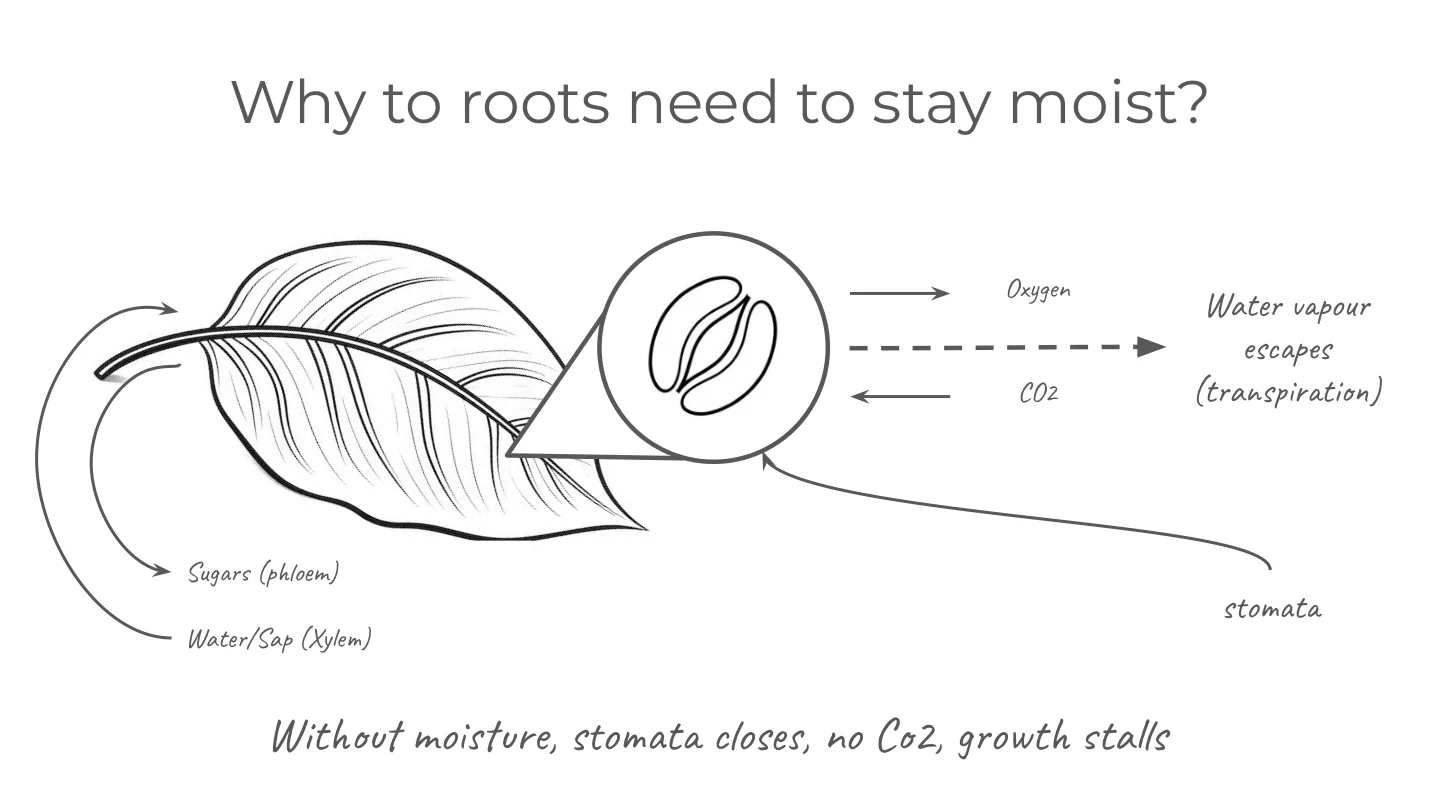
So roots need to stay moist, but they also need air. That balance is where your soil mix comes in. There is no magic combination, only a mix that suits your lifestyle and environment. If you can only water every second day you will need a mix that can cope with that, and there will always be a compromise, perhaps slower growth or less aggressive repotting.
Size and material matter
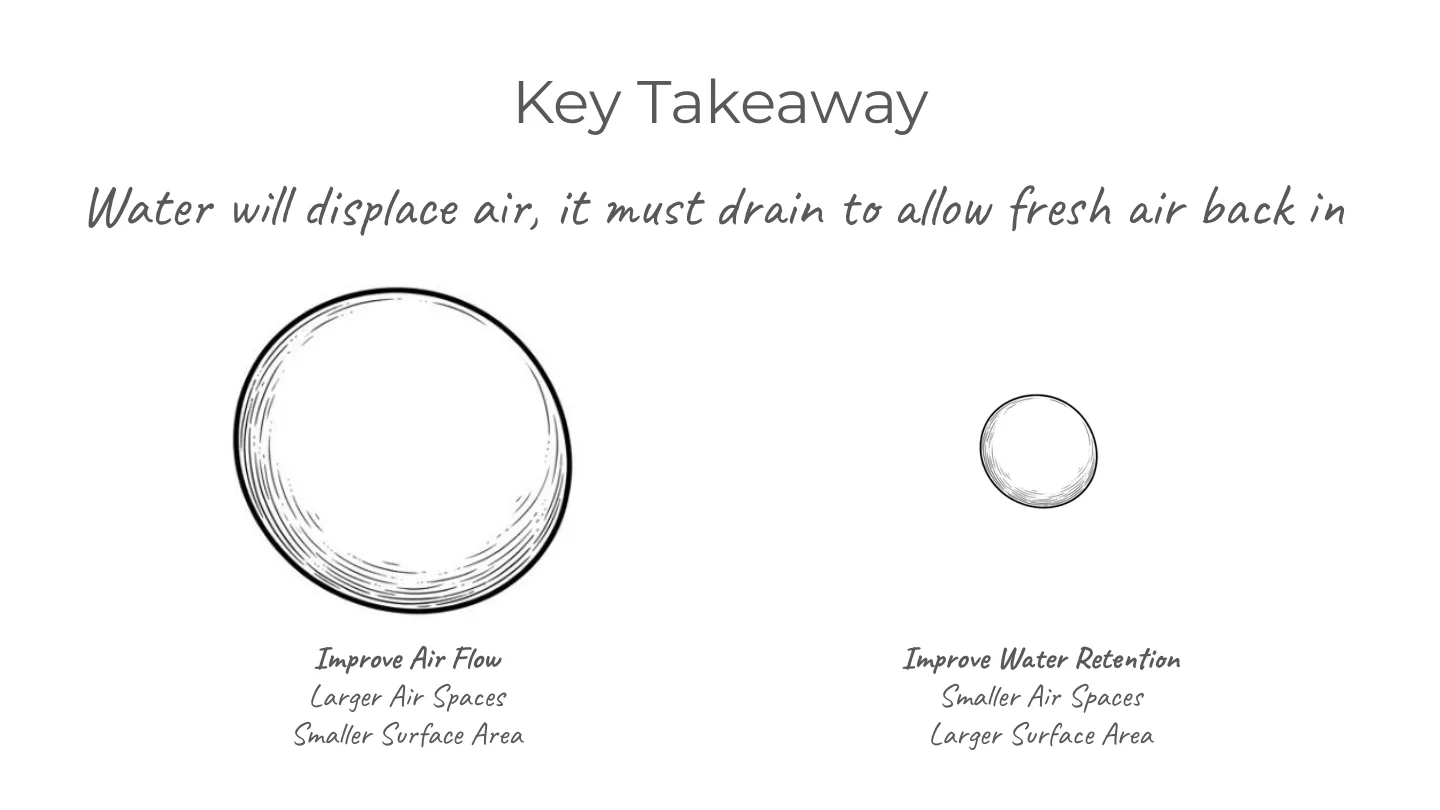
Water displaces air. If you want a mix with better airflow, you use larger particles with larger gaps between them. If you want better water retention, you use smaller particles. The reason comes down to surface area.
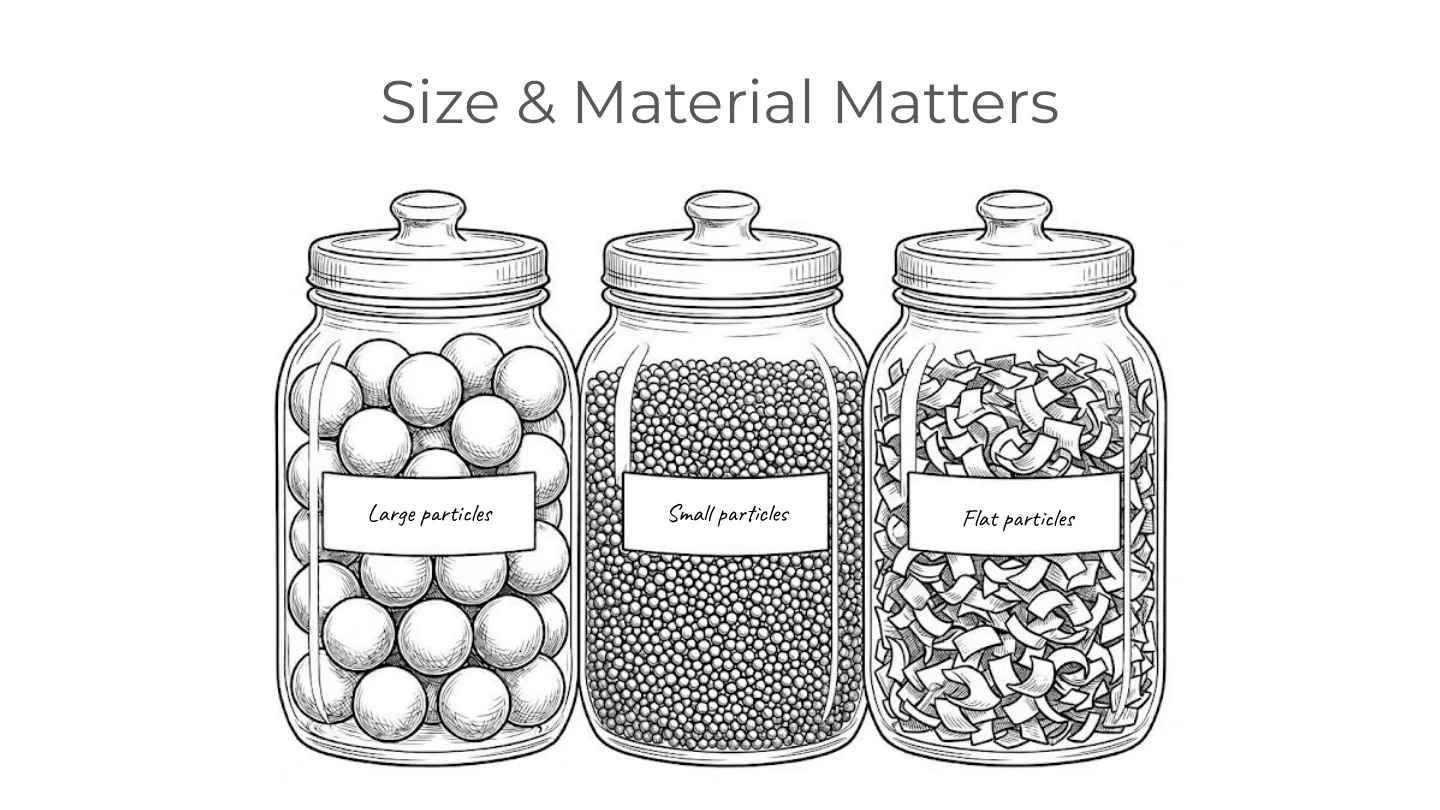
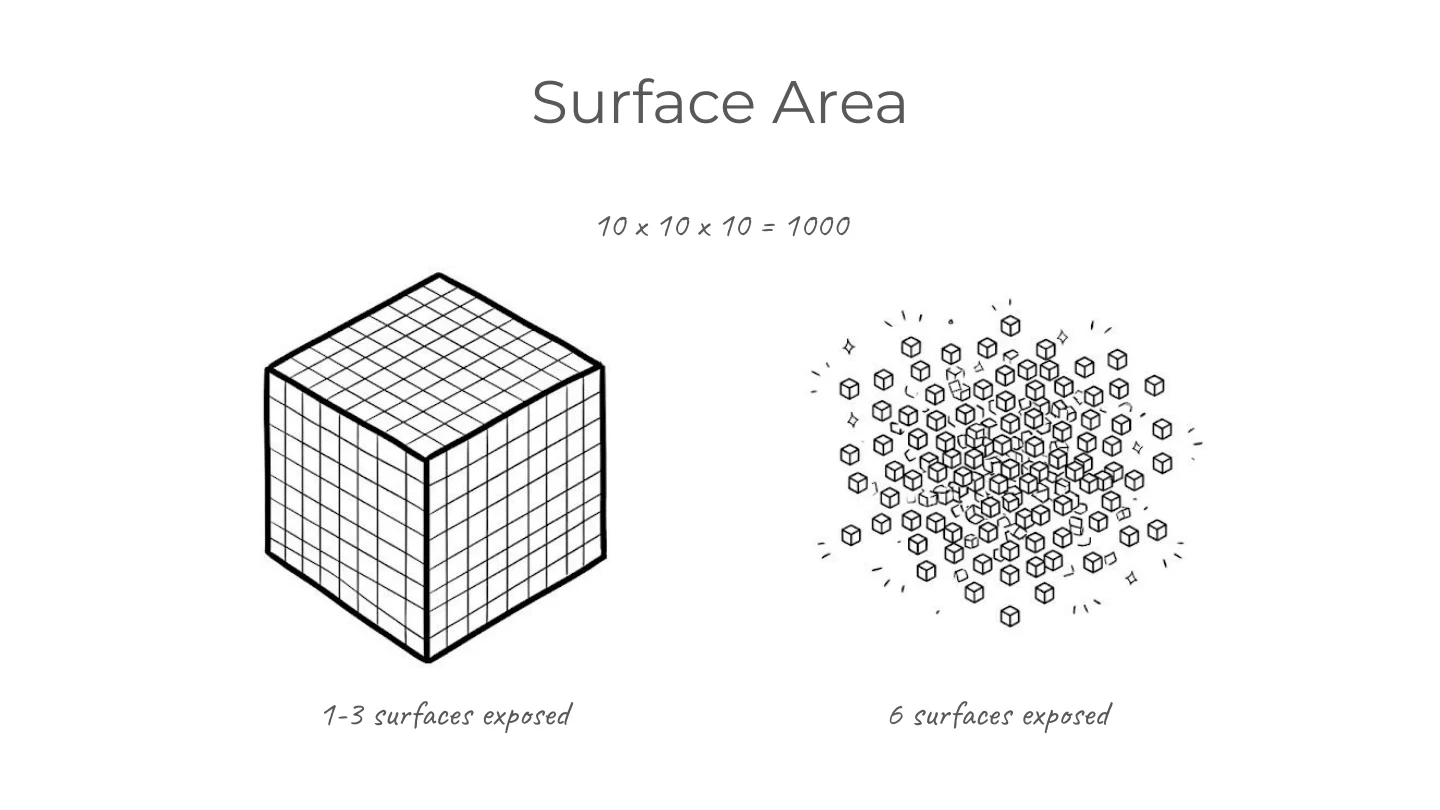
Water clings to the surface of particles in a thin layer. Take one sphere with a 10 mm radius. It has a volume of 4,188 mm3 and a surface area of 1,256 mm2. Now take 1,000 spheres with a 1 mm radius. The total volume is exactly the same, 4,188 mm3, but the surface area is 12,560 mm2, ten times more. Ten times more surface for water to hang onto, and less room for air.
I could not get my head around the sphere version, so I imagined a Rubik's cube instead. One big cube has a few faces. Cut it into a thousand little cubes and suddenly there are faces everywhere.
The key takeaway is that water displaces air, so it must drain to let fresh air back in. Larger particles mean larger air spaces and less surface area, which improves air flow. Smaller particles mean smaller air spaces and more surface area, which improves water retention.
Structure
Not all soil materials are made the same. For example pumice and scoria are related, both are volcanic rock that frothed with gas as it erupted and set full of tiny bubbles, however the rock formation and mineral make up creates differences. By contrast river sand is made when granite weathers into solid grains of mineral with no air inside. You can crush all three to the same size but they are very different inside. That structure changes everything.
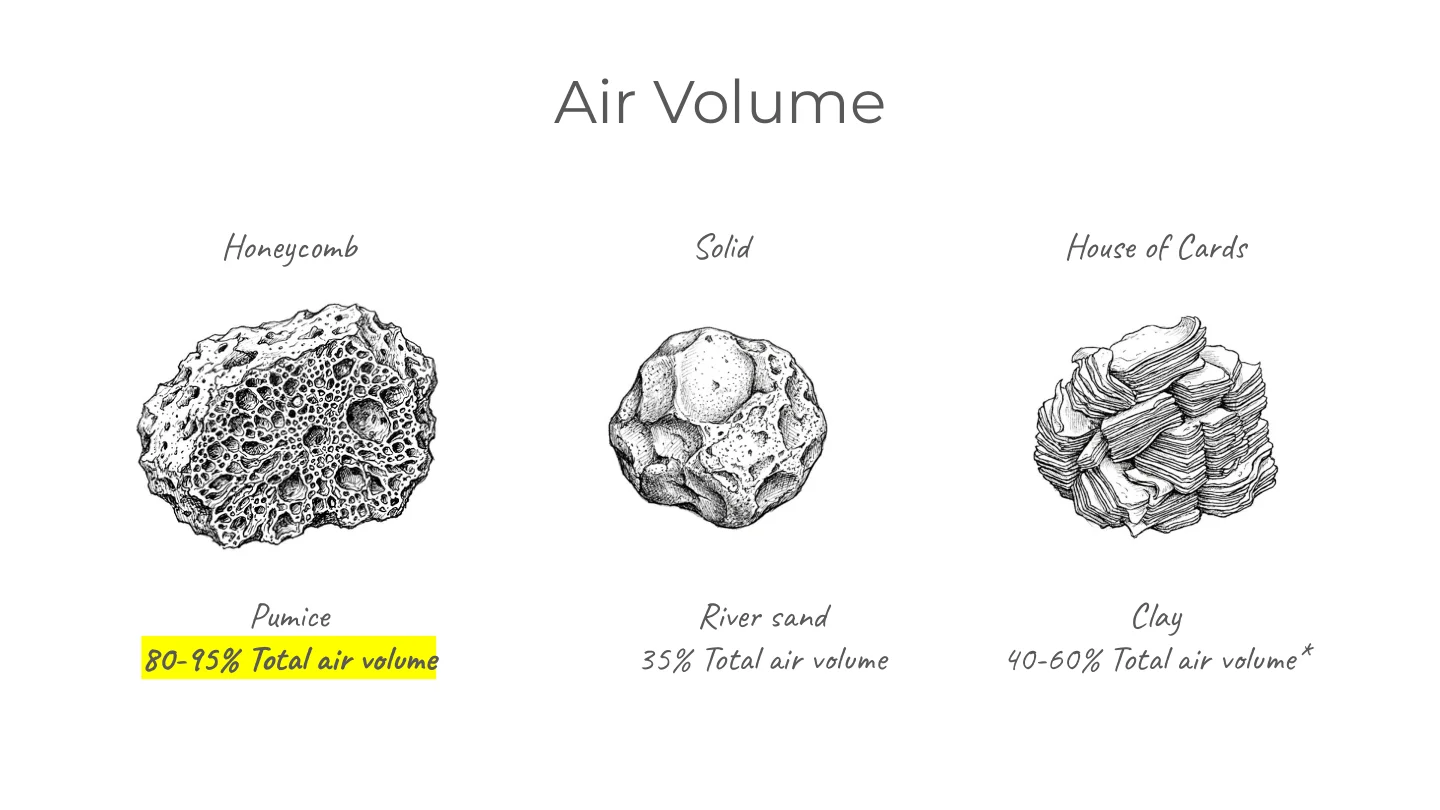
Pumice has a honeycomb structure. Around 60 to 90 percent of each piece is internal air, plus gaps between the grains, for a total air volume of roughly 80 to 95 percent.
River sand is solid. No internal air, and about 35 percent air between the grains. It still helps by creating gaps next to other particles, but that is all it does.
Clay is stacked plates, like a house of cards. It has plenty of room (porosity) but very few doors (permeability). Over time, usually three to five years depending on the clay, it breaks down and compacts, and the air goes with it.
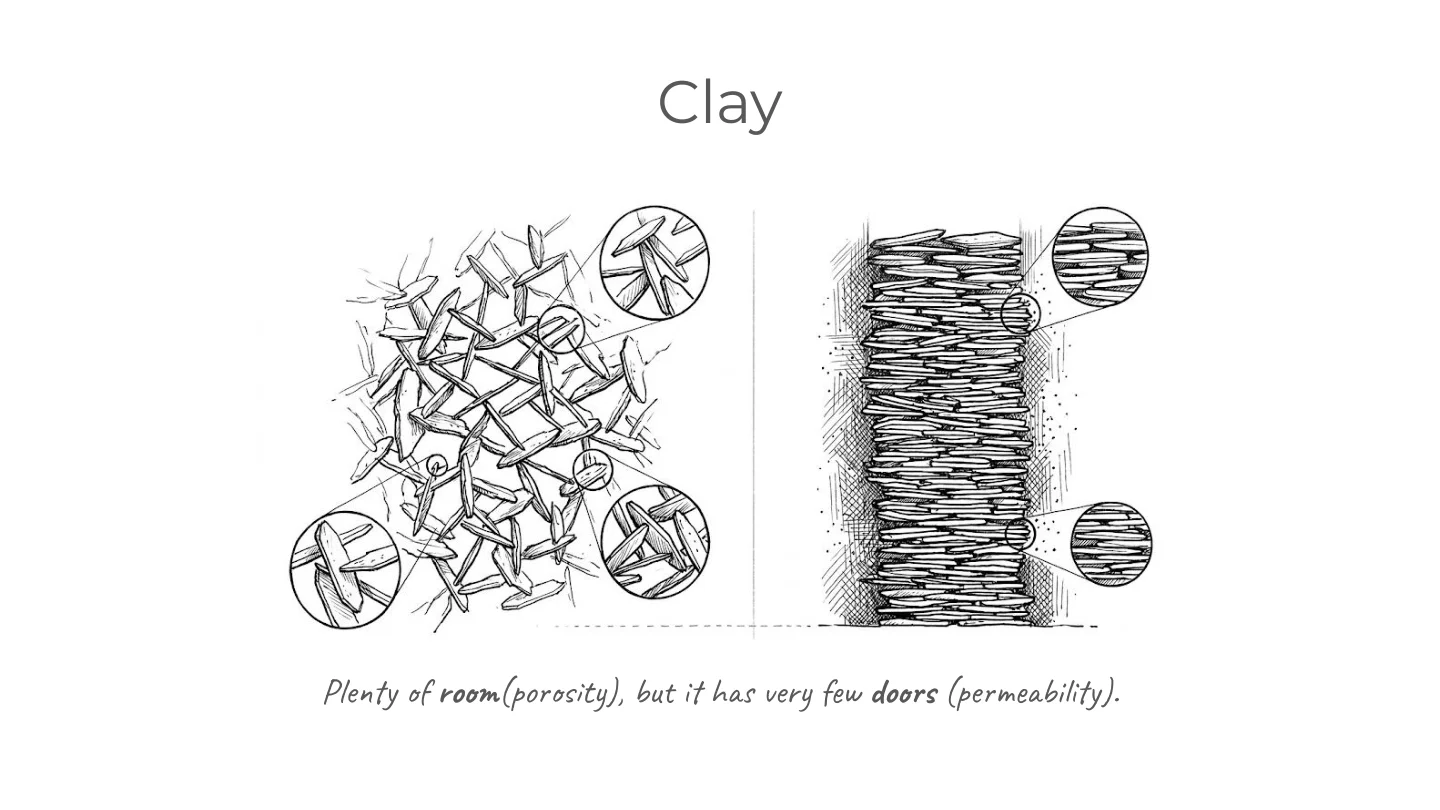
That is why people pair clay or organics with pumice. The pumice holds its structure and keeps the air in there even as the clay degrades.
Scoria sits somewhere in between. It has bigger pits and less honeycomb, so it is heavier, sharper and adds weight to a pot. Sharp, jagged pieces also seem to put insects off. My pumice is mostly 1 to 7 mm and my scoria tends to be around 5 mm, so I mainly use scoria to create gaps and add a bit of weight.
Durability
Durability is important for our mix as in part it determines the repotting frequency. We need the material to last 1-5 years depending on the stage of development and the species growth habits.
River sand is close to permanent.
Pumice is very durable. Under enough pressure it will eventually crush down to dust.
Clay degrades. If you use it, stay on top of your repotting.
Pine bark still decomposes, but it is the preferred organic. It has some internal air space and gives gaps at the right size. It is also chemically fortified armour, full of resins the tree made to push back fungi, bacteria and insects, but its decomposition is random, the pieces don't all break down at the same rate.
The ideal mix balances air space, water retention and durability and you want it to last the three to five years that your tree might spend in the pot.
Does too wet really cause root rot?
This is a golden rule that floats around, that you can overwater a bonsai. In a free draining mix I think it is very hard to do. It is much easier to underwater.
The problem is not the water, it is the lack of oxygen in the water. If water pools in a dip in the pot and sits there, it loses its oxygen and becomes a great home for pathogens like Pythium and Phytophthora. Those pathogens are probably already in most soils, just dormant, waiting for the right conditions. A healthy tree with breathing roots usually fends them off. So root rot is mostly about the environment and a lack of oxygen, not water by itself.
In a heavy potting mix that holds water and never dries out, you can definitely overwater. In a free draining mix, it is very hard to overwater.
When I first moved to a free draining mix I was worried. I watered, the water gushed straight out the bottom, and I was convinced my tree would dry out to quick. I messaged Scott Martin, whose mix I was following, and he said no, that is what you want. He was right. Being used to potting mix, I had learned to watch water sit and slowly seep through. When soil looks shiny, that is saturation and water has latched onto every particle, resulting in very little air in the mix. Until it drains, it cannot pull fresh air in and the bonsai will suffer for it.
Nutrition and a living soil
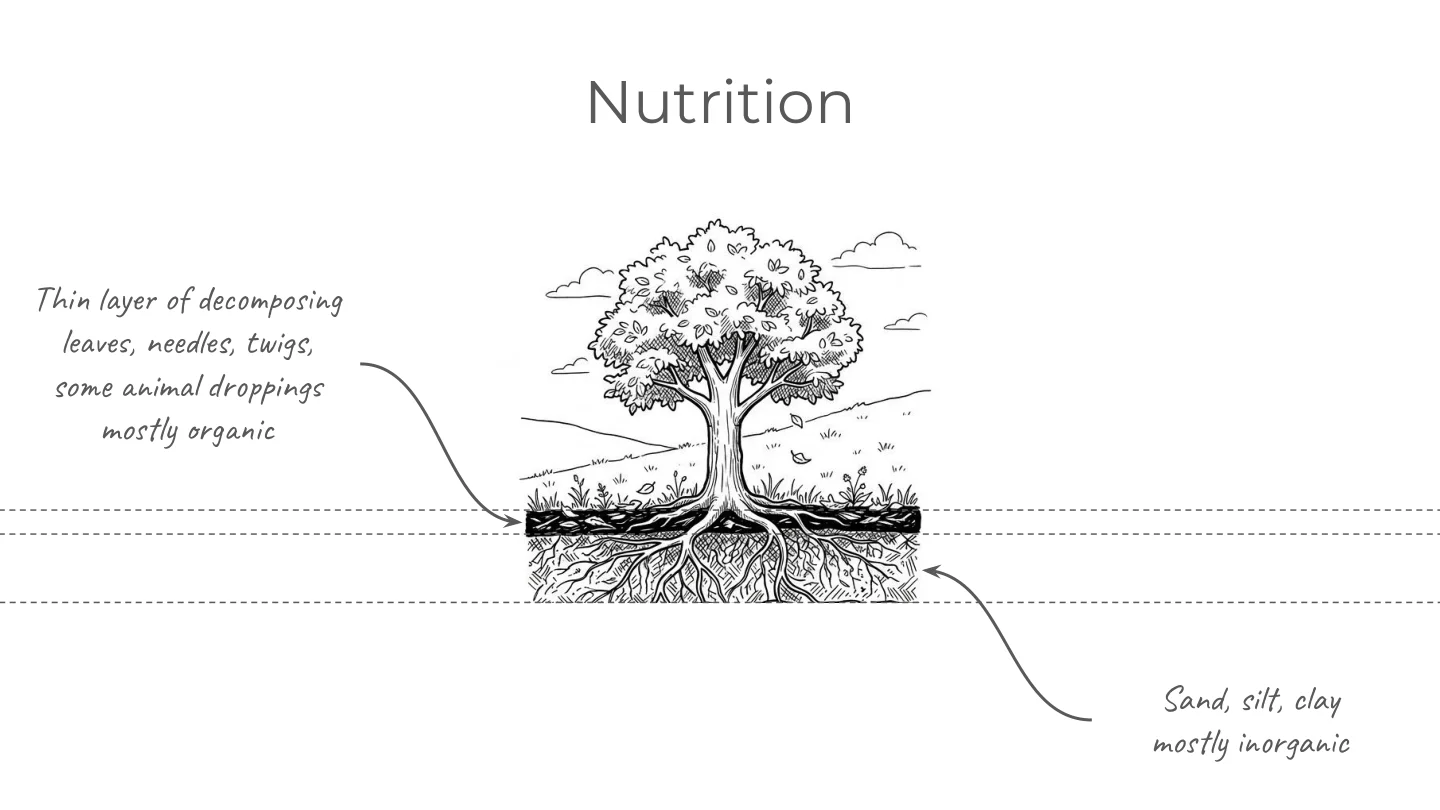
Trees still need nutrition, they just take surprisingly little from the soil. They need around 17 to 19 elements to build bark, leaves and flowers.
In nature the nutrient rich layer is a thin layer on top made up of decomposing leaves, needles, twigs and droppings. The roots mostly grow below it in sand, silt and clay, which is largely inorganic. Worms and insects shred the organic layer, bacteria and fungi break it down chemically, and symbiotic fungi called mycorrhizae trade water and nutrients to the tree in exchange for sugars. Pines are especially good at this.
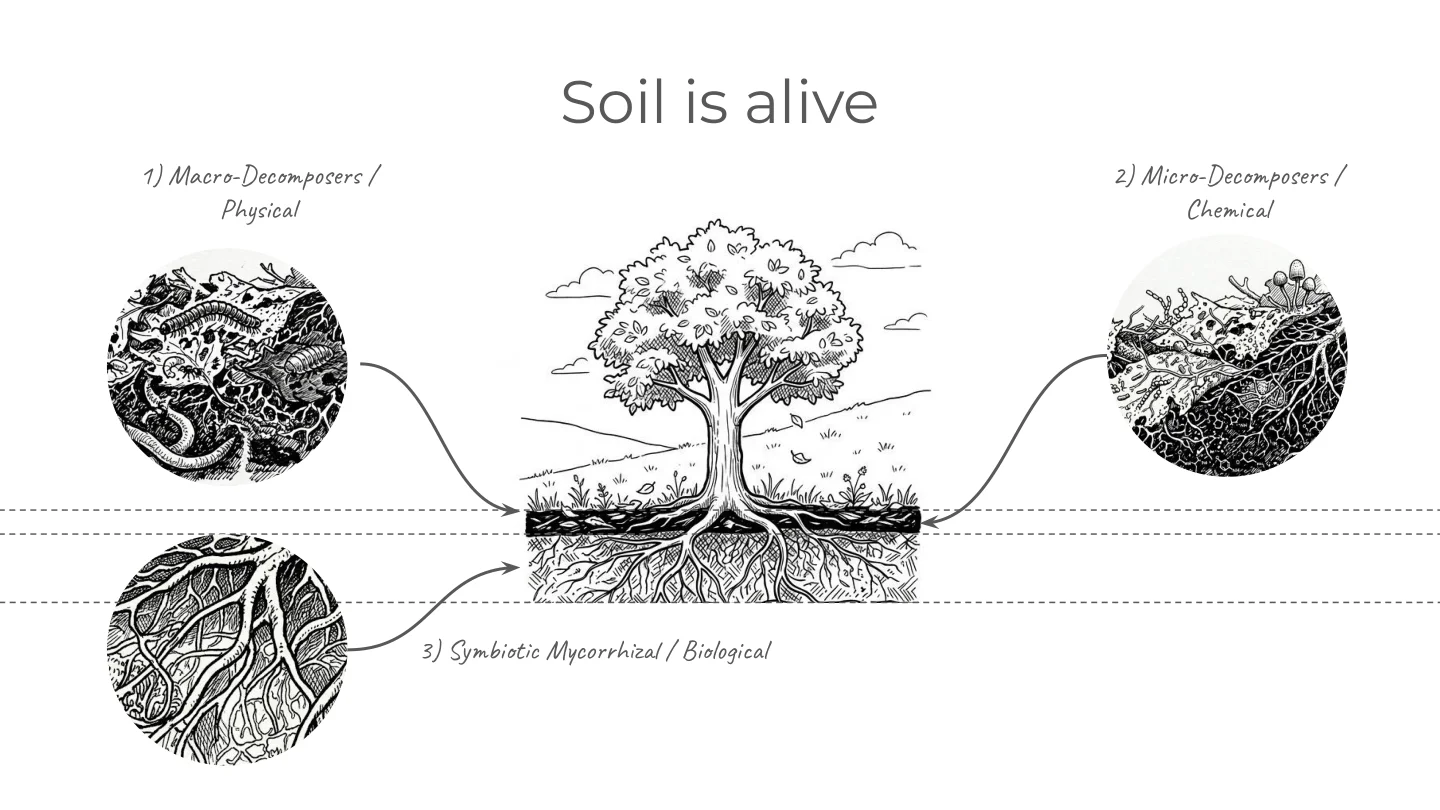
In a pot we usually do not have that whole system going on, but the pots are small and we fertilise right next to the roots, so they can absorb it directly. Mycorrhizae just make the whole thing far more efficient.
Container growing
Water behaves very differently in a pot than in the ground. In the ground, the soil is one big connected sponge, and water moves to wherever it is needed by capillary action. A pot is not connected to anything. Everything in it is what we put there.
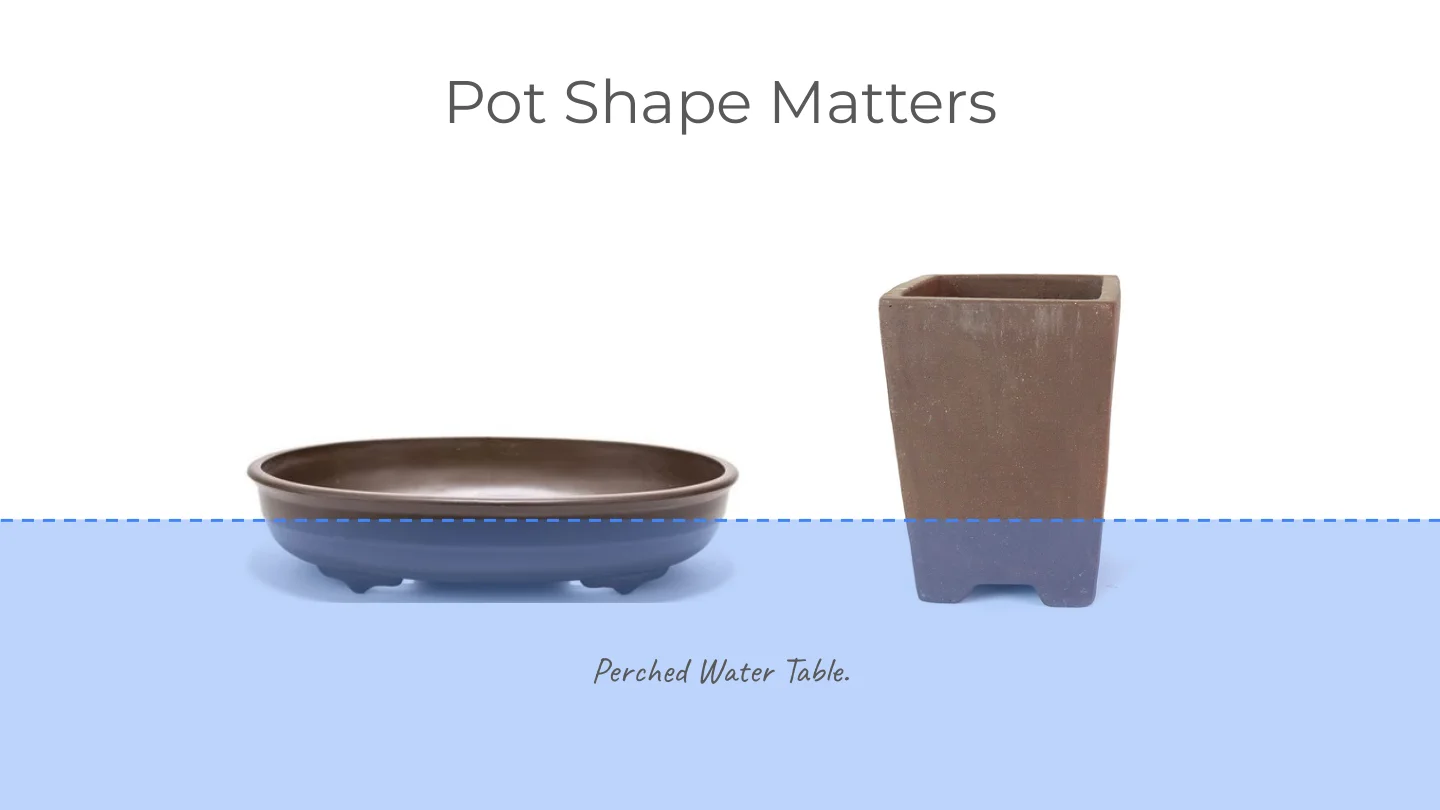
In a pot there are two forces at work, gravity and capillary action. Gravity pulls water down and out, and as it drains it pulls fresh air in from the top. That is how oxygen gets into the root ball. Capillary action, the way water molecules attract each other and cling to particles, works against that. Where the two balance you get a perched water table, a layer at the bottom of the pot that stays saturated no matter what the mix is.
Pot shape matters. If you want to visualize this, get a large sponge, wet it and then hold it vertical, as it drains you will see it reach a point where it stays wet. Repeat the process but hold it horizontal. The wet line roughly stays at the same depth, but the volume of saturation is very different. In a shallow pot that layer is a much bigger share of the volume. Half the volume of a shallow pot can be saturated, versus a quarter of a tall one.
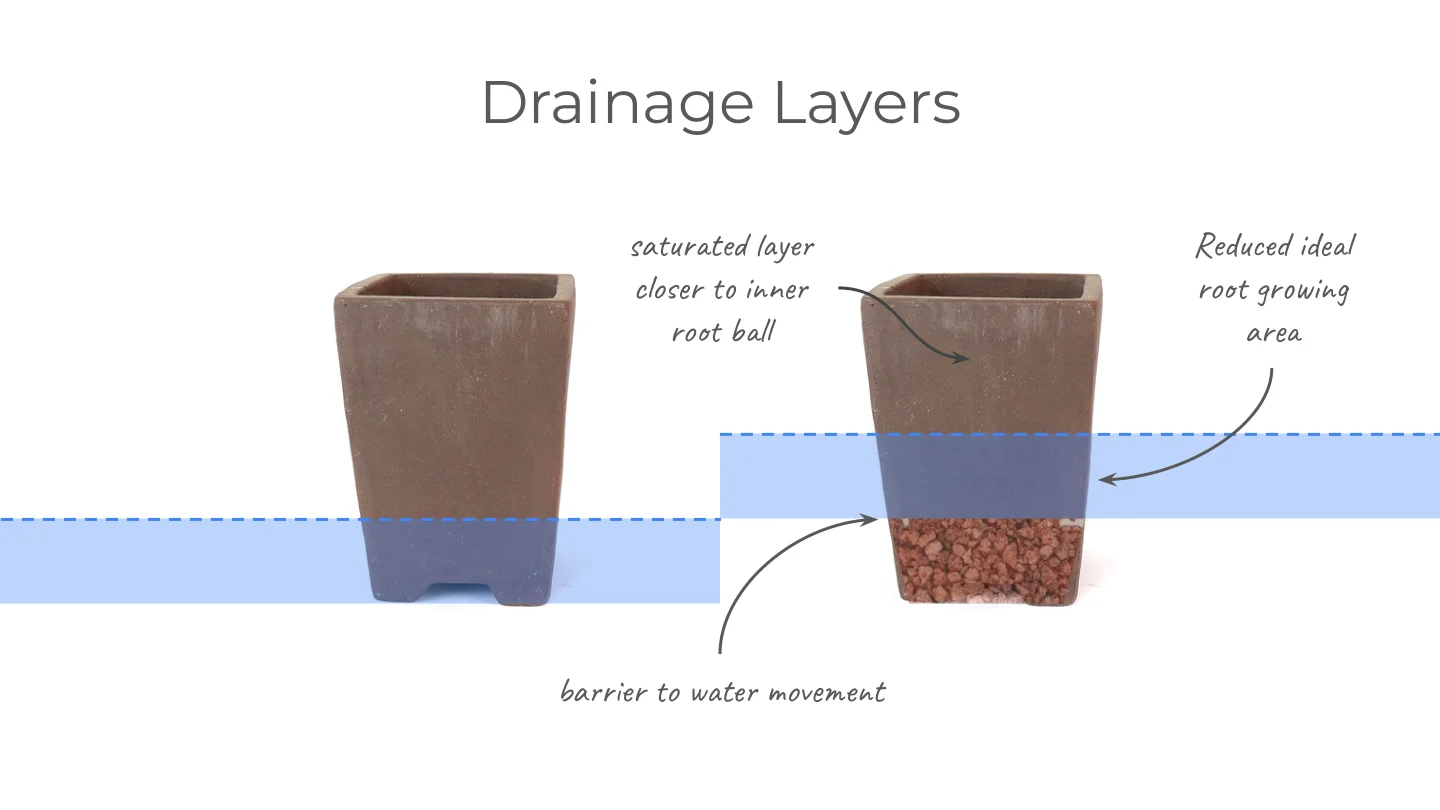
Drainage layers are counterintuitive. A thick layer of gravel in the bottom of the pot does not make it drain better. It creates a barrier to water movement and lifts the perched water table up into the root ball, so there is more saturated soil closer to the roots and less usable root space. A thin layer can help, because bonsai pots only have a few drainage holes, but keep it thin.
Making your mix
This is where the consensus sits today, as far as I can tell. People choose different ingredients, but most would agree on the following for a free draining mix:
- 60 to 70 percent inorganic
- 30 to 40 percent organic
- 3 to 6 mm particles
What you want from it is air space, water retention, the ability to hold fertiliser, a healthy microbiome and longevity of two to five years.
I do not sieve my mix. I have a couple of hundred things growing and the waste would be too expensive. I rinse the pots after repotting to get rid of the fines, and I pull out anything clearly oversize for a small tree. If I am working on a 50 or 70 year old tree I would be a lot more careful. I would be wary of layering different particle sizes, because that creates a barrier for water moving through the mix.
Fertiliser holding capacity matters more for me because I cannot use organics on top, as the dog and the possums would rip my trees apart. So I use pelletised fertiliser and liquid feed, and I want a mix that holds some of it.
I made a table comparing materials. It is subjective, so have your own opinion on it, except for the cost column, which I did work out from what I spend. The broad picture is that inorganics like pumice and scoria give you oxygen, while vermiculite, peat and sphagnum give you water retention, and zeolite stands out for holding fertiliser.
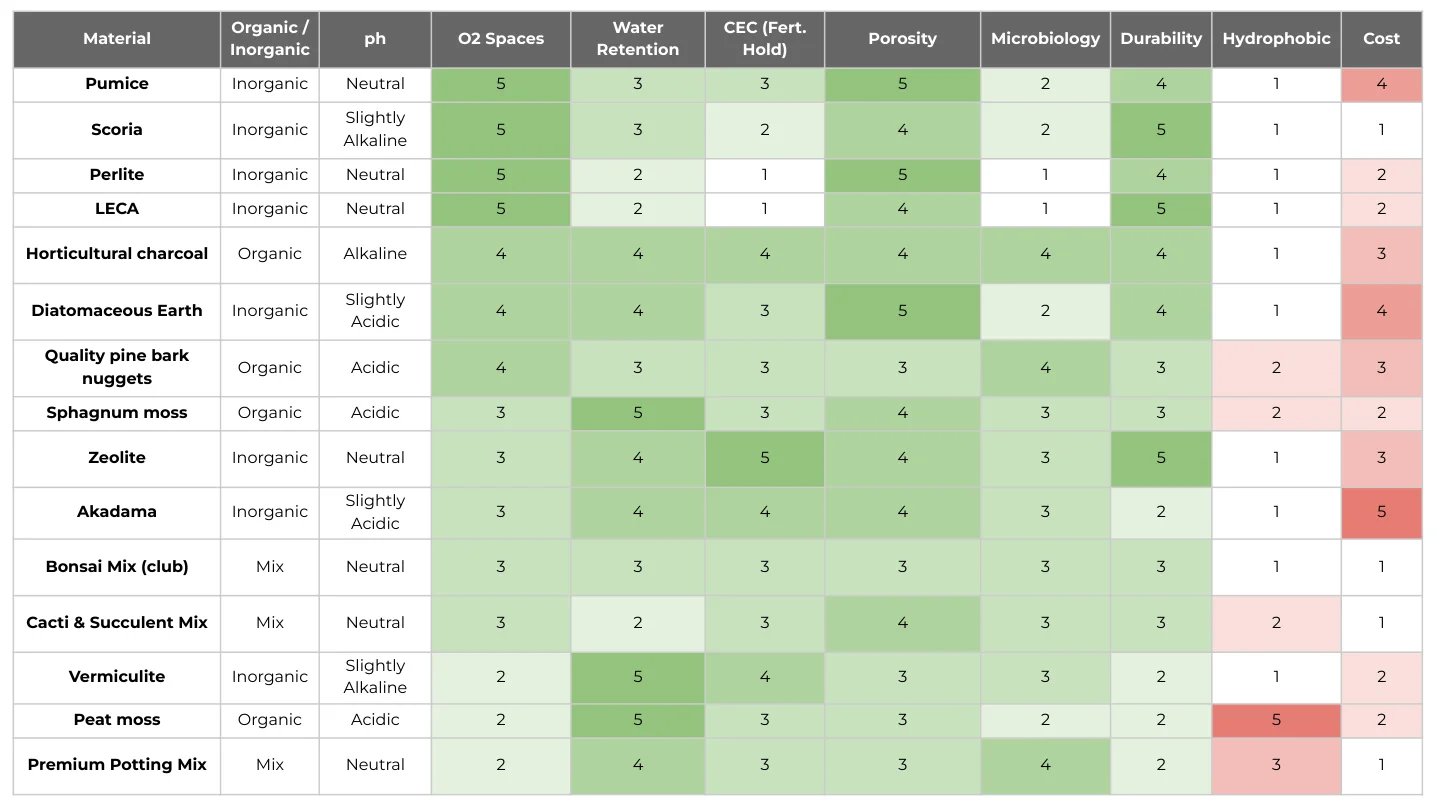
Source matters too. Quality material is worth paying for, and the pumice I use is washed and clean. Even a club bonsai mix is great value for what you get.
Mixes to consider
A mix that is mindful of cost. 30 percent scoria (under 7 mm) and 70 percent cacti and succulent mix. It lacks a lot of the benefits of pumice, and I would not really recommend it, but I would rather you use this than potting soil.
A bonsai premix from a club. River sand, bark and so on, around 1 to 7 mm. I used these for a while and my trees grew well with no issues.
The base mix. Equal parts, 33.3 percent each, pumice (1 to 7 mm), scoria (under 7 mm) and pine nuggets (3 to 7 mm). This is pretty much Scott Martin's mix. Scoria is the annoying one. You can get it from places like Soilworks and Fultons, but it is sandy, full of fines and the particle size is all over the shop.
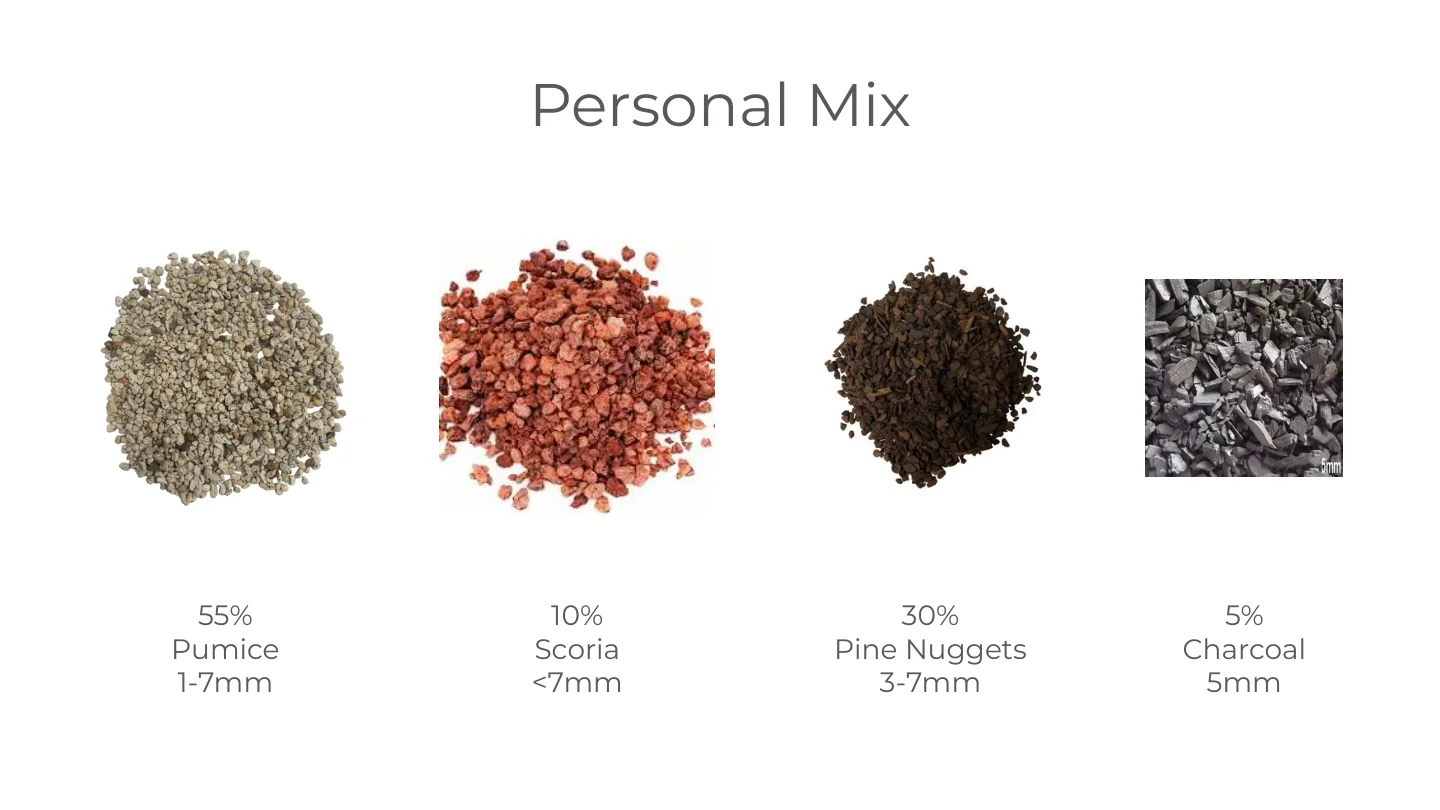
My personal mix. 55 percent pumice (1 to 7 mm), 10 percent scoria (under 7 mm), 30 percent pine nuggets (3 to 7 mm) and 5 percent charcoal (5 mm).
I added charcoal because it is an organic material that acts like an inorganic one. It is effectively dead, so it does not break down like pine, it is good for microbiology, and I am hoping it holds on to some of the fertiliser from all my liquid feeding. I could probably swap it for zeolite. The point is I did not put in 30 percent. I threw in a small fraction, and only about a third of my trees are in that mix so far. I will compare them against the others over a few years.
That is important advice for any mix. Do not go out and repot your whole collection into something you heard about in a talk. Pick a subset, and maybe not your favourite tree first. See how they grow and expand from there.
The 20 scoop method
I mix everything by hand, by the bucket, and I go by volume, not weight. Pumice weighs next to nothing compared with scoria or pine bark, and what matters is the volume of soil in the pot. Twenty scoops in one bucket looks like 11 pumice, 2 scoria, 6 pine nuggets and 1 charcoal. That is 55, 10, 30 and 5 percent, with no measuring. I fill buckets as they empty out over the repotting season, from early winter through to spring, and I can easily go through 12 to 14 bags of raw materials in a season.
What it costs
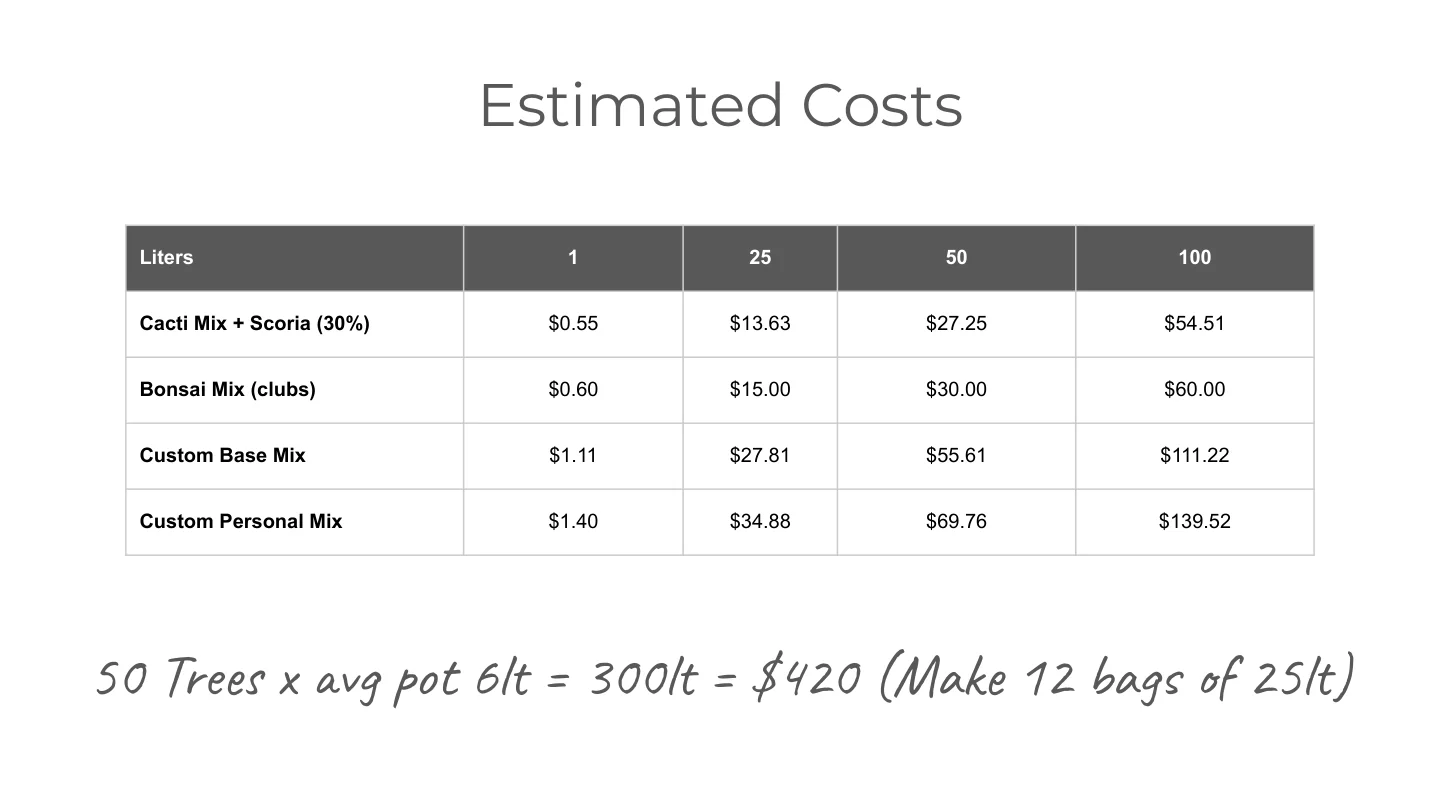
This year I will spend somewhere between $400 and $500 on raw materials. I repot everything in the same mix, whether it is in development or refinement, because I believe a free draining mix grows the best root system. That is not for everyone. If you only have ten really nice trees, give them the good mix. It will last two or three years and you will get great health out of it.
A radiata pine, 20 years of neglect and a better mix
When I was 16 I was out in Gippsland with my grandfather, and I saw a small pine on the side of the road. He pulled over, and since it was winter I ripped it out of the ground with no shovel and threw it in the back of the car.
Over the years it went from the roadside to a pot, to the ground, back to a pot, and eventually into a larger pot. Along the way it spent a stint in hydroponics, in Leca balls, where I remember pulling it out and finding beautiful white roots. The roots clearly loved the oxygen. After that it spent years neglected in a back corner of my parents' garden, in shade.
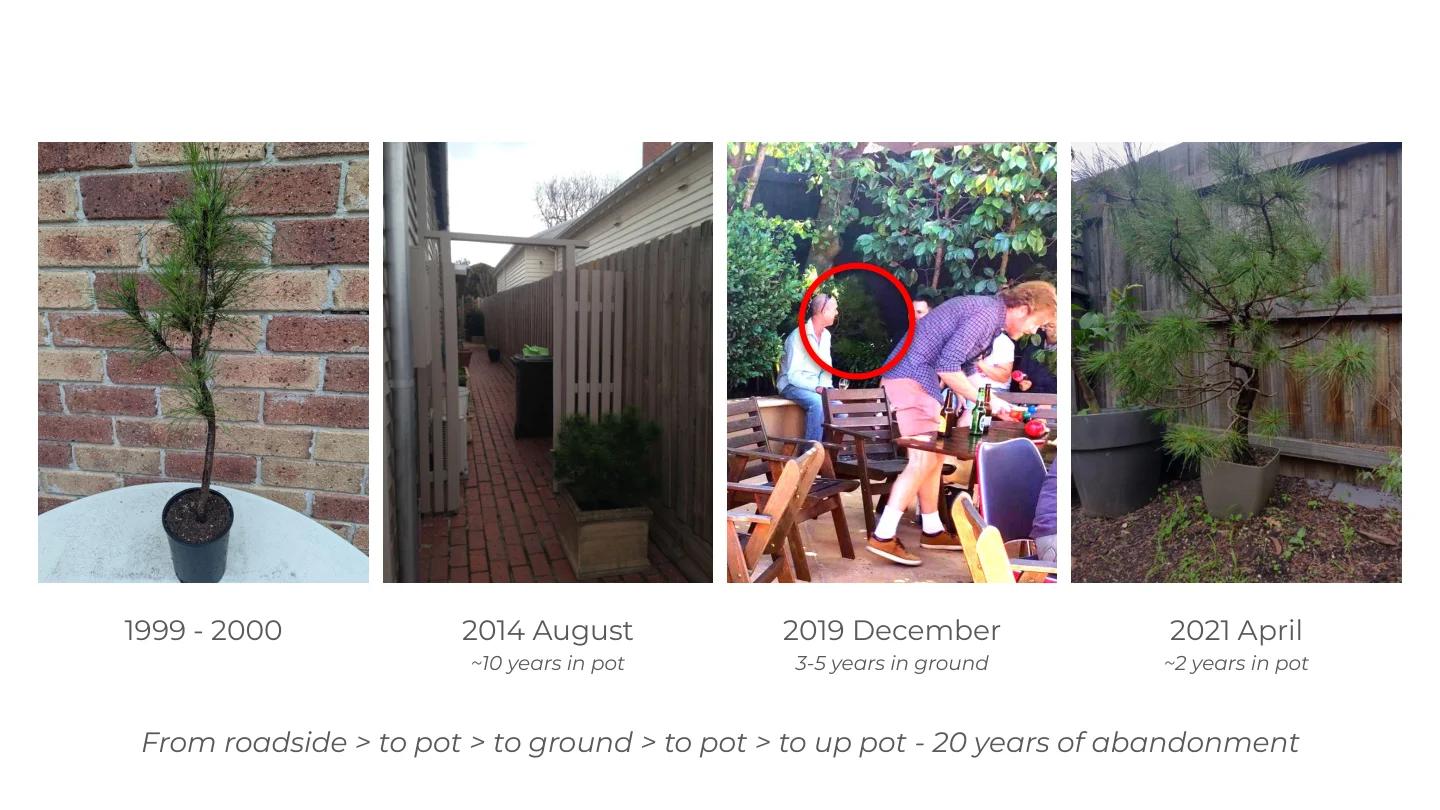
My parents dug it up in 2021 when they knew I was back into bonsai. I took it to the BSV pine meeting that year, where Scott Martin was talking about pines. I had no idea what to do with it. It was leggy and half of the back was dead. Scott said not to disturb the roots too much, but to split the root ball up the middle, get it into a good free draining mix and pile sphagnum moss on top. That is exactly what I did. When I moved it into the new mix I roughed up the edge of the old root ball a bit, because two completely different mixes in contact with each other make water run down the sides and out instead of through.
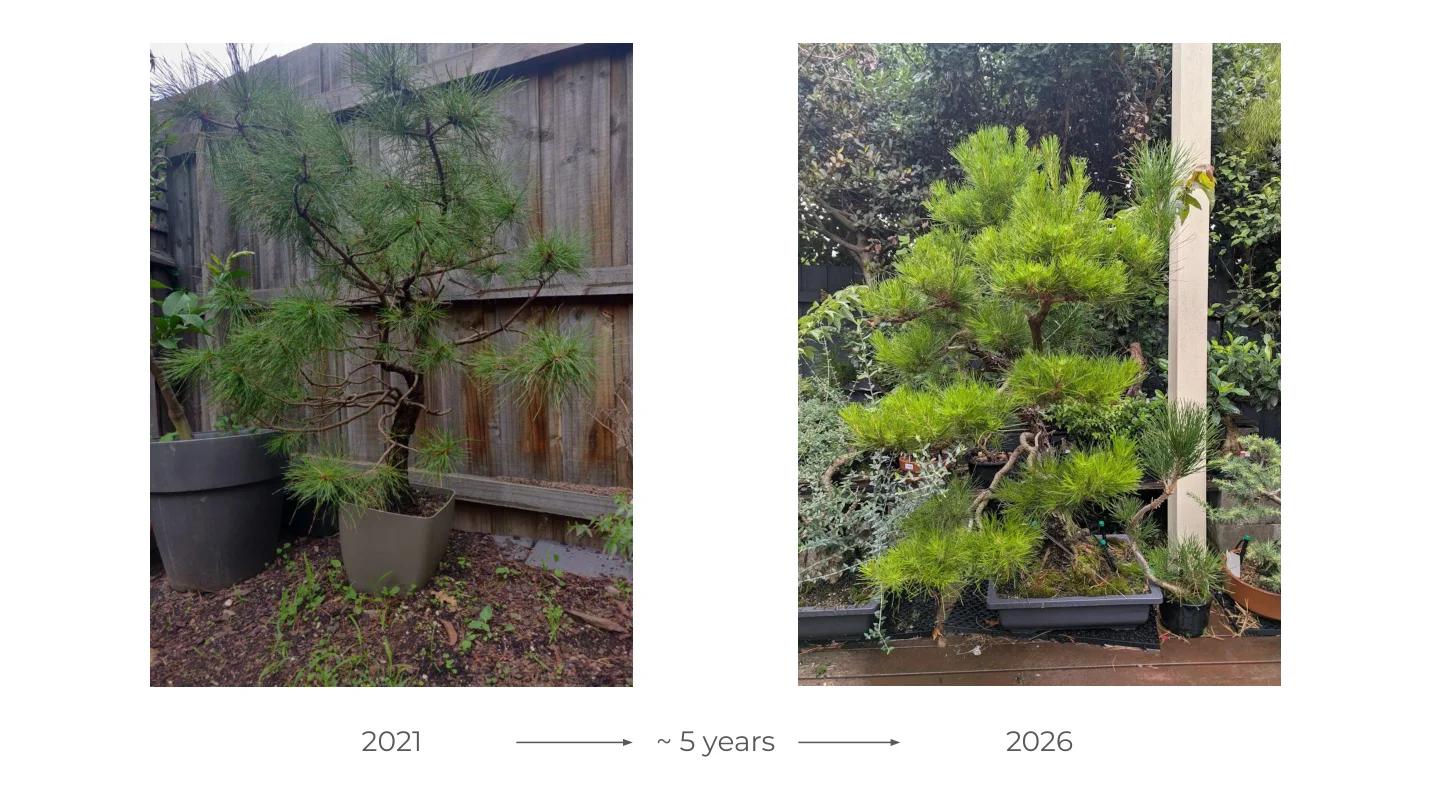
It exploded in growth. A few years of cutting it back and keeping it watered and fertilised later, the pot is packed with fine, fibrous roots that hold together beautifully. That last repot was in 2024, and it is not due for another year or two.
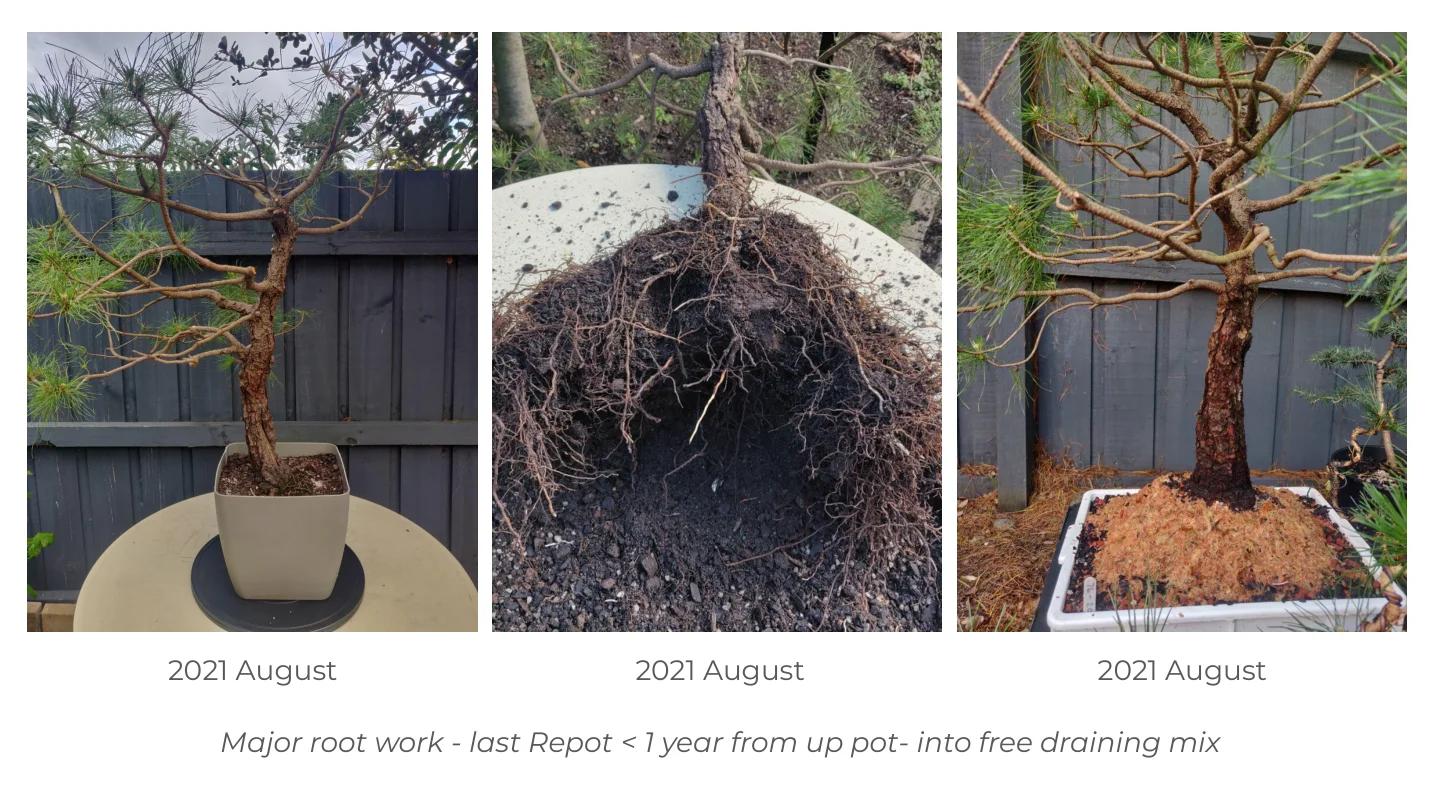
Twenty years of neglect, and now it bounces back every season. A lot of that is the mix, plus good watering and fertilising.
Thoughts on free draining mixes
Is it tough on tools and hands? Yes. Cutting through roots in stony mix blunts scissors, so keep them sharp.
Does the soil drain too fast, or dry too quickly? Draining fast is not an issue, but it does dry out quickly. With 60 to 70 percent grit it does not hold water like other mixes. On hot summer days I water three times a day, and I built a drip system to help. If a tree is drying out too much I put a very thin dusting of sphagnum moss on top, or a tray underneath. Not every tree drinks at the same rate, so I still go round with a hose for the thirsty ones.
Will it support thickening? I worried about this, as I want big extensions and thick trunks. I have not found it to be a problem. I have trees about 3 metres tall and very thick in 30 cm orchid pots, and they love it. It is never as good as the ground or a very big pot, but it has not slowed my extension growth.
When should I use a quality mix? For me, always, but see the cost section above. If your budget is tight, put your best trees in the best mix.
Should you recycle old soil? I generally do not. You would have to sieve out all the roots, bake it in the sun, and by then the pine is gone anyway. You also risk contaminating the next tree. For big trees still in development I sometimes do half old and half new, because filling one of those pots costs about $50. Old mix is perfect in the garden.
Takeaways
- Free draining mixes promote excellent gas exchange, which creates healthy bonsai.
- Experiment with a mix that works for your situation.
- Do not repot everything into a new mix.
- Focus on best practice repotting techniques.